
Effective communication is an essential pillar for successful teaching and learning. As a physics teacher, I must be able to clearly explain complex phenomena in a way that is meaningful to my students. While I provide students with opportunities to explore and make their own discoveries, as a content expert, I am able to offer valuable insights into the observations they make and guide discussions that connect different ideas. I utilize verbal, visual, and written forms of communication when interacting with my students on a daily basis. As we moved to a remote teaching model, I moved away from the traditional discussions in front of a white board to video presentations, but still seek to include the same opportunities for students to practice problem solving and see interesting phenomena demonstrated. A sample of this form of communication is included in Artifact 1 on the “Informed Decision-Making” page of my portfolio.
Communication is not limited to the transmission of content knowledge from the teacher to the student, but rather, it requires a dialogue between all invested stakeholders (students, teachers, administration, and parents). In order to invite other stakeholders into the conversation, I try to make the practices that I employ in my classroom as transparent as possible. The artifacts below illustrate my proficiency in communicating with students and parents, two audiences who are essential for successful student learning.
Artifact 1: Communication of Lesson Plans
The first audience that I need to communicate with is obviously the group of students that I teach directly. I strive to develop clear lesson plans that are available to students ahead of time so that they can plan for future learning or get caught up if they unexpectedly miss class. I have explored different modalities of communicating this information, ranging from a teacher website through the ‘old Google Sites’, to Google Classroom, a personally developed calendar system, a “new Google Site’, and finally back to Google Classroom.
One of my more immediate adaptations to my teaching in response to remote instruction during Covid 19 was the final transition back to Google Classroom. I was an early adopter of Google Classroom when it became available in our district, but had chosen to use an alternative method of communicating with students, as there were significant limitations in the customization and function of Classroom at that time. You can see an example of my self developed class calendar here.
While this model was less than perfect, it afforded me the opportunity to easily modify my planning schedule while still giving students an ability to look several weeks ahead at topics and resources to be explored. It also provided a much more teacher-friendly method of recording my lesson plans – I was able to quickly review the pacing of all activities from the prior year when planning future lessons. The original Google Classroom, on the other hand, required several minutes of scrolling through the classroom feed to locate plans from the previous September, and trying to print it out was a disaster. When our district transitioned to fully remote operations, it was required that all teachers use Google Classroom, which fortunately has been vastly improved (though not perfected) upon the earlier version.
To streamline communication in this current digital venue, I have structured my Classroom into a separate unit for each major topic explored in class. A typical unit will likely be two to three weeks in duration, and I typically post an assignment or resource for every class period. To help students differentiate between posts at a glance, I have implemented a system of emojis that reflect the type of material included in that post.
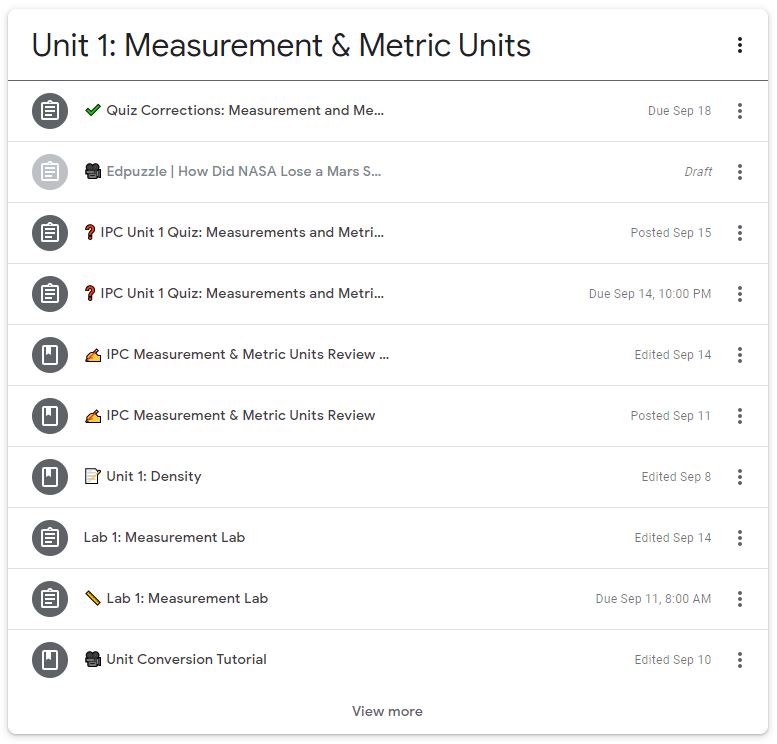
I include a breif summary or instructions in each post so that students know where to get started. Assigned due dates are clearly indicated ahead of time. By maintaining this system of organization, students are aware specifically what is expected of them and when it needs to be completed by. I was an active member of the “Teaching and Learning” committee through Summer of 2020, and part of my involvement included developing best practices for teacher use of technology such as Google Classroom during periods of remote/hybrid instruction.
I should mention that while I utilize technology to disseminate my lesson plans to students, I seek to maintain two way communication by inviting students to offer feedback of current lessons. That feedback shapes my future planning, as illustrated through Artifact 3 on the “Informed Decision-Making” page of my portfolio.
Artifact 2: Maintaining Communication With Parents
Students who have strong supporters of their education at home are much more likely to succeed in the classroom, so I strive to engage parents and guardians (referred to as ‘parents’ moving forward) in conversations around their student’s progress in my class. This has become increasingly necessary in the era of remote learning, as it is much easier for students to disengage with school when attending from home. I was proactive to reach out to parents when I noticed patterns of absences, missing work, or general confusion about the topics explored in class. I am intentional to communicate to families that I care about the student, clearly identify the areas of concern, and suggest a plan to remedy the situation. I think that this is a form of communication that I am fairly successful in utilizing, as I have received commendations from my administrators and many thankful responses from parents for my thoughtful communication. It does take some time to write emails in this detail, but I find that it is time well spent as I am often successful in supporting students to get back on track. I do think that proactive positive communication with families is also important, and I make an effort to highlight student achievements as I observe them.
Some might argue that email is not cutting edge technology, but I believe that its affordances of accessibility and familiarity maintain its usefulness as a primary mode of communication. Email is very accessible to most parents, particularly with access to mobile technology. Although I would prefer in person meetings or phone calls to discuss sensitive issues with parents, the reality is that I have found I am able to reach parents and resolve issues via email much faster than we can coordinate a time for a phone call, especially in recent years. Email is also familiar to parents as they already use it for personal communication. This makes reduces the barrier of learning a new digital platform to communicate with each of their students’ teachers.
 physicseveryday.com